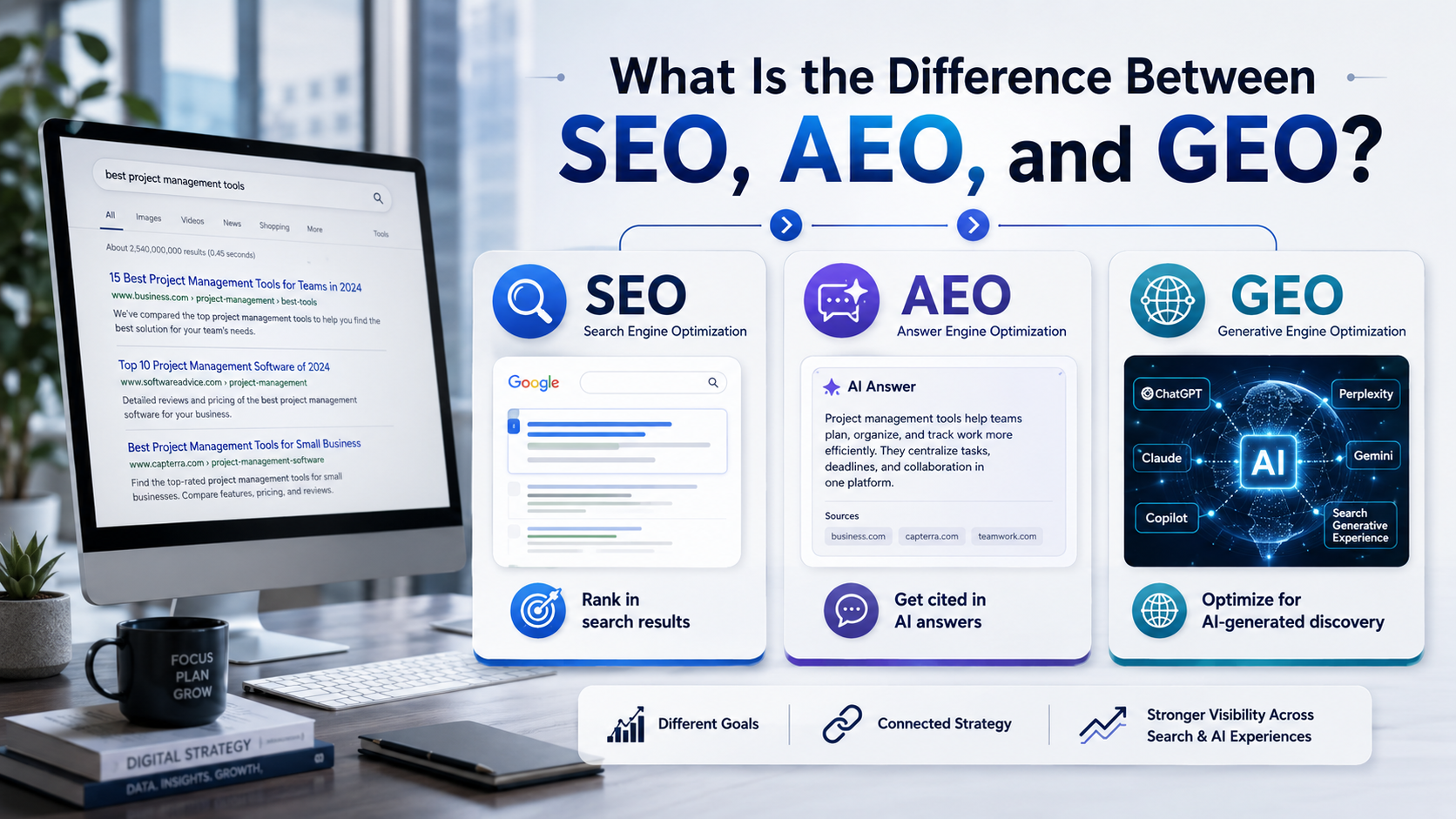
What Is the Difference Between SEO, AEO, and GEO?
SEO, AEO, and GEO are three search strategies that share a foundation but aim at different targets: SEO earns rankings in traditional search, AEO earns direct-answer citations, and GEO earns mentions inside generative AI tools. They sound almost interchangeable, but each one optimizes for a different way customers now find businesses. Understanding the difference is the first step to staying visible as search splits across Google, AI Overviews, and chatbots.
If you want the full side-by-side, our team put together a complete SEO vs AEO vs GEO breakdown that explains how each one works in practice. The short version: these aren’t competing choices. They’re layers of one modern search strategy, and the businesses that combine all three will own the most visibility going forward.
Since 2009, Local Blitz has helped companies in Indianapolis and San Diego adapt every time search evolves — and the rise of AI-driven discovery is the biggest evolution yet. Here’s exactly how SEO, AEO, and GEO differ, and how they fit together.
SEO, AEO, and GEO Are Three Layers of the Same Modern Search Strategy
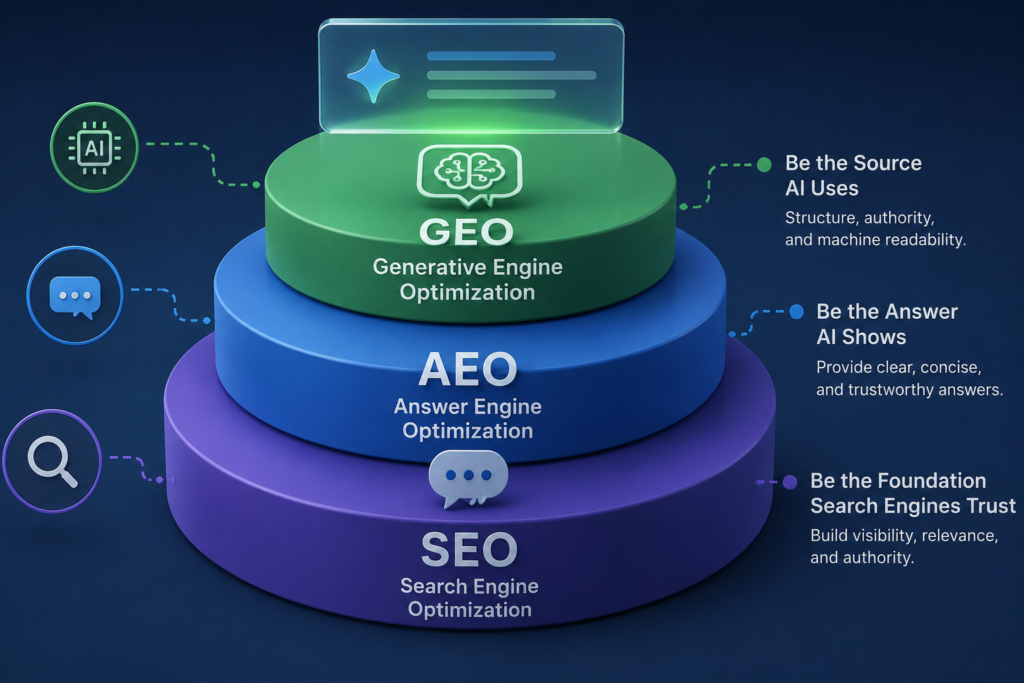
SEO, AEO, and GEO are best understood as layers, not rivals — each one extends your visibility into a different part of how people search today. SEO covers the classic search results page, AEO covers direct answers and featured snippets, and GEO covers generative AI tools like ChatGPT, Perplexity, and Gemini. They overlap because they all reward clear, trustworthy, well-structured content.
Here’s how the three compare at a glance:
| SEO | AEO | GEO | |
|---|---|---|---|
| Full name | Search Engine Optimization | Answer Engine Optimization | Generative Engine Optimization |
| Main goal | Rank high in search results | Get quoted in direct answers | Get cited by AI tools |
| Where you appear | The list of search results | Featured snippets and AI Overviews | ChatGPT, Perplexity, Gemini responses |
| What it rewards | Relevance and authority | Clarity and quotability | Trust, specificity, and structure |
| How you measure it | Rankings and organic traffic | Snippet and answer visibility | Brand citations and AI referrals |
The key insight is that strong SEO feeds both AEO and GEO. The clarity, authority, and trust you build for one layer carry directly into the others.
SEO Is About Ranking Your Website in Traditional Search Results
Search Engine Optimization is the practice of improving your website so it ranks higher in traditional search results like Google and Bing. It’s the original and still-essential layer — the work that earns you a high position and the click that follows. Without it, the other two strategies have nothing to build on.
SEO covers a wide set of activities, including:
- Keyword and content strategy — targeting the terms your customers actually search.
- On-page optimization — titles, headings, and content aligned to search intent.
- Technical SEO — site speed, mobile-friendliness, and a crawlable structure.
- Authority building — quality backlinks and a credible reputation.
SEO has been the backbone of Local Blitz campaigns since 2009, and it remains the foundation everything else is built on.
AEO Is About Getting Your Business Quoted in Direct Answers
Answer Engine Optimization is the practice of structuring content so search and AI tools can extract a direct answer and cite your business as the source. Instead of competing only for a high ranking, AEO competes to be the exact sentence a featured snippet or AI Overview repeats. It’s how you win visibility even when the user never scrolls to the classic results.
Content built for AEO tends to share a few traits:
- Direct answers first — the response leads the section instead of hiding in it.
- Defined key terms — clear, quotable definitions near the top of the page.
- Structured formatting — headings and lists that are easy to extract.
- FAQ sections — concise answers that feed People Also Ask and voice search.
AEO is the bridge layer — it takes the authority you built with SEO and reshapes your content so it can be quoted directly.
GEO Is About Being Cited by Generative AI Tools
Generative Engine Optimization is the practice of making your content the source that generative AI tools choose to cite and repeat. As more customers ask ChatGPT, Perplexity, and Gemini for recommendations, GEO ensures your business shows up by name inside those AI-generated answers. It’s the newest layer, and the one most businesses haven’t addressed yet.
GEO emphasizes the signals that make AI tools confident in a source:
- Authoritative, specific content — real expertise, not generic rehashing.
- Clear structure — a logical hierarchy AI can parse and chunk accurately.
- Citable statements — short, factual sentences an AI can lift and attribute.
- Schema and trust signals — structured data and credentials that confirm legitimacy.
Because GEO is still emerging, the businesses that act now have a real chance to claim citations before their competitors catch on.
Which One Does Your Business Actually Need?
Most businesses need all three — but in a specific order, starting with SEO as the foundation. You can’t meaningfully optimize for answers or AI tools if your site isn’t already authoritative and well-structured, because every layer draws on the same underlying trust signals.
A practical way to prioritize:
- Start with SEO — build the technical health, content depth, and authority everything else relies on.
- Layer in AEO — restructure your strongest content to answer real questions directly.
- Extend into GEO — reinforce the trust and structure signals that get you cited by AI tools.
For local and service-based businesses, this sequence matters even more, because “near me” intent shows up across all three layers at once. At Local Blitz, we build campaigns that strengthen each layer in turn rather than chasing one in isolation.
How Do SEO, AEO, and GEO Work Together?
SEO, AEO, and GEO work together because they all reward the same core qualities: clear content, strong structure, and genuine trust. Improve those fundamentals and you lift all three layers at once — which is why treating them as separate projects usually wastes effort.
The compounding effect looks like this: SEO earns the authority that makes you eligible for citations, AEO formats your content so it can be quoted directly, and GEO carries that trust into AI-generated answers. Each layer reinforces the next, and a weakness in one drags down the others. This is exactly why we take a unified, data-driven approach rather than selling these as disconnected services.
Frequently Asked Questions About SEO, AEO, and GEO
Are AEO and GEO the same thing?
No, though they’re closely related. AEO focuses on getting your content quoted in direct answers like featured snippets and AI Overviews, while GEO focuses on being cited inside generative AI tools such as ChatGPT and Perplexity. They overlap heavily, but GEO is specifically about the conversational AI layer.
Do I need to choose between SEO, AEO, and GEO?
No — the best strategy combines all three. They’re layers of one approach rather than competing options, and they share the same foundation of quality content and site authority. Choosing only one leaves visibility on the table in the others.
Is GEO replacing SEO?
No. GEO builds on SEO rather than replacing it, because AI tools tend to cite sources that are already authoritative in traditional search. Strong SEO makes GEO far easier, which is why the foundation still comes first.
Which matters most for a local business?
SEO remains the top priority for local businesses, but AEO and GEO are quickly becoming essential as customers use AI tools for “near me” recommendations. The smartest move is to lock in local SEO first, then layer in answer and generative optimization to capture AI-driven searches.
Can I do AEO and GEO without good SEO?
Not effectively. Both AEO and GEO rely on the authority and structure that SEO provides, so weak SEO undercuts your results in the other two layers. Building a solid SEO foundation first makes everything that follows more achievable.
The Future of Search Belongs to Businesses That Master All Three Layers
The difference between SEO, AEO, and GEO comes down to where you want to be found: ranked in search results, quoted in direct answers, or cited by AI tools. They aren’t competing strategies — they’re three layers of one modern approach, all powered by the same commitment to clear, trustworthy, well-structured content.
The businesses that master all three will stay visible no matter how customers choose to search. If you’d like a partner to help you build that complete strategy, Local Blitz has been keeping businesses in Indianapolis, San Diego, and beyond ahead of search changes since 2009 — with a transparent, data-driven plan built around your specific goals. Search is splitting into new layers; now is the time to make sure your business shows up in every one.